Showing posts with label fiction. Show all posts

Monday, April 15, 2013

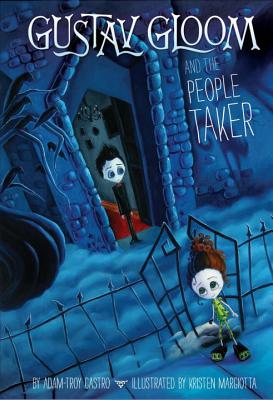
Gustav Gloom and the People Taker By Adam-Troy Castro


This book is a wonderful and frightful adventure like nothing I’ve ever read before.  I first noticed it while organizing middle reader series books at work.  There it was, all alone in the series section, with its promising grey cover of Gustav and his shadow.  I hadn’t heard anything about it at all, but I knew immediately that I wanted to love it.

Fernie What loves a good scare.  She dreams of living in a  creepy old house full of shadows.  So when she moves in across the street from Gusav Gloom, she is immediately drawn to his giant, black house, with its dark yard and blackened windows.  On her first night in her new home, her cat runs across the street and into Gustav’s house.  Fernie goes after it, not knowing the dangers (and adventures) that await her inside the big, black house.  She and Gustav are soon making a mad dash through the house to escape the People Taker, who has taken up residence there.  He plans to take Fernie and her family and drop them into The Pit that leads to the Shadow World.

The cover may have drawn me in, but the characters kept me reading.  Gustav and Fernie are at once loveable and admirable characters that made the book hard to put down.  Of course the action and plot were wonderful and I really, really wanted to know what would happen, but the thing that I loved more than anything else were those two.  Gustav, who is such a lonely little boy, starts to realize what it means to have a real friend.  He’s never even eaten real food before, or had a real hug.  The shadows that are his friends in the house hope that Fernie can change all of that, but first he has to save her from the People Taker.

Castro has a wonderful sense of humor.  It’s a kind of humor that is not always apparent in kid’s books.  It’s the kind of humor that kids, adults, and Krystas can appreciate.  Fernie’s Father is obsessed with safety and always paranoid that his kids will get hurt, but still fails to see that a maniac in a chef’s hat is not really going to feed him pancakes, but instead try and take his family.  Fernie is obviously upset that the People Taker is trying to hurt her family, but she’s deeply offended that he has no intention to feed them said pancakes.  Castro also has an appreciation and an understanding of the humorous, yet lovable, nature of cats, which is always a big hit with me.

Turns out I picked this book up just in time, as the second book in the series is due out in only a few days.  I can’t wait to get my hands on Gustav Gloom and the Nightmare Vault!  Maybe I’ll finally find out more about the mysterious Lord Obsidian, or perhap more about Gustav’s history.  Whatever is in the book, I’ll certainly be reading it under the covers by flashlight.


Monday, March 25, 2013

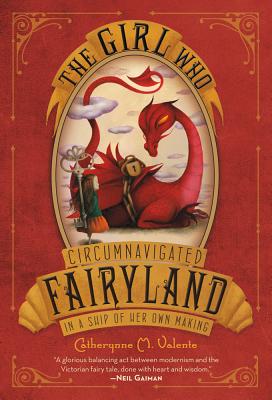
The Girl Who Circumnavigated Fairyland in a Ship of Her Own Making by Catherynne M. Valente


September is a very bored little girl.  Her father has shipped off to war and her mother is raising her alone.  Her mother works all day repairing engines in a factory.  They live in Nebraska, where there is nothing for a little girl like September to do.  She wishes endlessly to be taken off to Fairyland like so many bored children before her.  One day, while she is washing teacups, that wish comes true and September gets a visit from the Green Wind, riding on the Leopard of Little Breezes. They take her away to Fairyland, where she has the most amazing adventures.


The characters in this book are so unavoidably likable, despite their faults.  September is repeatedly called heartless, but we know she isn’t.  She is sometimes said to be selfish, but she is nowhere near it.  Even the villain is likable in her ability to be such a fantastic fairy tale villain.  Sure, she’s an evil ruler, but she’s just a kid.  An angry one at that. Of course the friends September makes along the way are the most wonderful friends anyone could ever hope to make. There's A-through-L, a Wyvern and Saturday, a marid, and of course Gleam, a kind-hearted paper lantern.


Valente is an exceptional writer.  She creates a Fairyland that is both familiar and fantastically strange.  Her imagination has run wild all over the pages of this book, and it’s a really, really mind-blowing imagination.  It’s not often that a writer can create a world so complete and easy to visualize.  Her descriptions are lush and vivid, even describing colors in more depth than I thought was possible.  It helps that she loves some of the same things that I do, like autumn and pumpkins and green smoking jackets, which she spends extra time applying her loving pen to.  Her vocabulary is luscious and so needed in books for young readers.


It’s impossible for me to write this review without pointing out the obvious fact that female characters like September are so needed in children’s literature.  September is an amazing little girl.  She makes friends easily and defends them without a thought.  She literally travels to the ends of the earth (without shoes, no less) to save them, and she does it alone.  She is willing to sacrifice everything for them. There’s no annoying underlying romance to it, as there is in other popular kids books.

It also helps that September is being raised by wrench-wielding, do-it-yourself mother, though we get only get small pieces of the woman she is. September
doesn’t get her strength from anyone but herself, which, like most of us, she has to learn along the way.

http://www.indiebound.org/book/9781250010193" target="_new">Buy it indie!

Monday, November 5, 2012

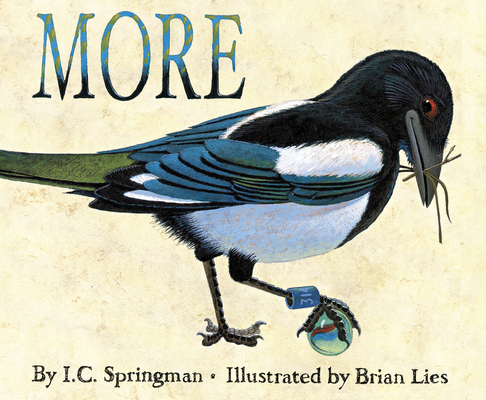
More By I. C. Springman, Illustrated by Brian Lies

Target Audience: The child of a book lover, especially, or any kid, age 1-7ish.

This is one of the best children's books to come out this year.  There are other great kid's books (which I'll try to get up before the holidays), but none that I love so much as this one.

The story is about a magpie that, in the beginning, has nothing.  Its mouse friend gives it a marble and it understands what it means to have something.  Suddenly the magpie wants more.  Just a little more.  Then a lot more.  And then way, way too much.  Luckily the mouse is still there to help.  It's a valuable lesson in a culture where your life's value can seemingly be measured by how much you own, rather than how much you really need.

One of the things I love about this book, is how few words it has.  Most of the story telling is inferred with pictures and left to the imagination.  That paragraph above has more words than the whole book, so it's great for the very little ones, and those just learning to read.  These factors will allow the book to grow with the child.  Kids at different points in their life will get different things from the book, so it's not like a board book that you read to a toddler a few times and then may end up throwing away when the child outgrows it.

The pages are full of all of the things the magpie has collected, like marbles, string, coins, stamps, toys, everything.  There's even a Pink Floyd cassette tape, which is obviously there for the adult reading the book, because the current generation has never seen or heard of a cassette tape (I know this because when I told a girl the only audio book available for the book she wanted as on cassette tape, she had no idea what I was talking about, which lead her mother and I to exchange a "kids these days" look).  Having all of these items adds another layer to the interactivity of reading to a child.  Even if the child can't read, perhaps she can count the marbles?  Maybe he can find all of the purple things?  What kind of coin is that? Where do you think that Lego brick came from?  Someone I sold it to planned to use it with kids with learning disabilities, which again, illustrates its versatility.

You can't talk about a kid's book without also talking about the art.  It is fantastic.  To me, a children's book is just as much art, as it is story, so even if the story is great, the art has got to support it.  Because the art does most of the story-telling in this book, there's even more pressure for it to be great, and illustrator Brian Lies lives up to my completely objective and outrageously-high standards.

I could never recommend a children's book if I didn't think it would be cherished forever, and perhaps saved for future children.  After all, I still own my favorite childhood books.


Buy it indie!

Tuesday, April 6, 2010

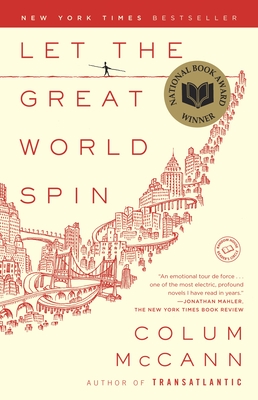
Let the Great World Spin by Colum McCann

I've always been captivated by stories of New York in the 70's and 80's, back when it was still a dangerous and trashy city, when Times Square was all smut and crime, without the Disney musicals.  Let the Great World Spin takes place in that era.  It has all the dirt and grime, but it is a story about people, so it also has their hope.  The stories move between the South Bronx, the Upper East Side and the Financial District (the southern tip of Manhattan).

The book takes the stories of many different people, from all parts of life, and weaves them together slowly and delicately.  Most of them do not even know they are connected; they may sense it, but they will never fully understand it.  An Irish priest and his brother, living in the South Bronx, one to find the underworld, the other trying to get out of it, become entangled in the lives of a group of prostitutes.  A rich mother loses her only son in Vietnam and tries to find other mothers to connect with.  A lost artist gets into a car accident that will change the course of all of their lives and set the story fully in motion.

The stories are all fictional, but they have something very important, and completely true, in common.  In 1974 Phillipe Petit strung a wire between the Twin Towers and by walking across it he created an instant network of people, all connected by the same miraculous moment.  Petit created one more piece of web to connect all of these stories.  At the very height of their stories, the climactic turning point, they all experience the man dancing on the wire between the Twin Towers.  His 140 foot length of cable, somehow crossed over the entire city at once, From the South Bronx, to the Upper East Side and back to the Financial District.

I loved this book.  It's definitely a must-read for any fiction lovers.

Monday, February 1, 2010

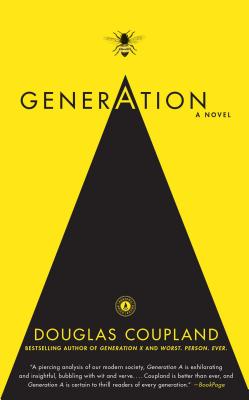
Generation A by Douglas Coupland

Douglas Coupland's writing is a little Chuck Palahniuk, without trying as hard to be clever, and a little Kurt Vonnegut, though not so cynical. This book is not his first novel, but it almost reads like one. It doesn't make me interested to read his other books anytime soon, which is a bummer because I had high hopes for this book.

The story is about the foreseeable future when bees have gone extinct. No one has seen them for at least five years. Suddenly 5 different and seemingly unrelated people get stung. The book is told from their individual perspectives. Coupland does a good job of giving them all different personalities, though the writing style for each voice is basically identical. I found myself having trouble believing that the perceptive introvert was perceptive at all in certain chapters. At times he told his story like an ignorant fool.

I had bigger problem with the pacing. The story was all beginning and end, with no middle to speak of. We start out with the 5 people getting stung and they are whisked away to underground labs to be studied for a month, without explanation as to why. Then they go home, but before anything can happen there, they are whisked away yet again to a remote island where they find out why they were stung and what the results of being locked away underground were. Why even have them go home at all? Coupland seemed to be in a rush, but nothing gets me into a book like a writer who savors the story.

But I don't want to be misleading, it's a fun book and Coupland has a smart writing style. It was an easy read and an enjoyable one. It simply wasn't my favorite and I won't be rushing to re-read this book. I still stand by it being an interesting story idea, I just wish there could have been more to it. In a way that's a compliment. It's not like I didn't finish the book; I liked it enough to want more from it.

Monday, January 11, 2010

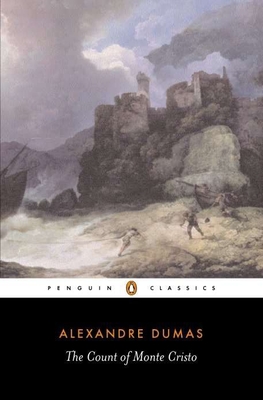
The Count of Monte Cristo by Alexandre Dumas

I can't review this book. How could I review this book? I feel like a fraud. What right do I have to write anything about this amazing story? It's a classic for a reason! It's so perfect and meticulous. Dumas created the most amazing and perfect characters and had no trouble whatsoever bringing them to life. There's not a speck of laziness in his writing. He takes no shortcuts, creates no miracles without explanation, and he runs the reader through every possible emotion throughout the story.

Edmond Dantes is wonderful. He's an honest and good person and he's perfect in so many ways. If he's slightly conceited, it is only because he is too young to know any better. When he becomes the Count of Monte Cristo he is conceited because he has learned to know better. He is the ultimate instrument of revenge and wrath. He is so perfect and adept at his revenge that at times it gets away from him, it takes on it's own life. He forgets that he is human and I found myself forgetting as well. However, Dumas reminds his readers before he reminds The Count. We see what is about to unfold just before Dantes and just after it is too late to stop any of it. The revenge is so perfectly plotted, no detail is left out. However, it is impossible to know the full extent of it, only because it impossible to know any person to the fullest extent. Who knows just how far any one character will go? No one but Dumas it seems.

The ending. Oh the ending. Of course I would never reveal the ending. But, oh is it perfect. Amazing. A believable fantasy, just like the rest of the book, but somehow even more so. And just like the rest of the book it is impossible to say just what happens after the last page. The story will never rest, because, like life, there are no tidy endings. Like life, you can never really know what path people will choose, or what tomorrow will bring.