Showing posts with label great gift. Show all posts

Monday, March 25, 2013

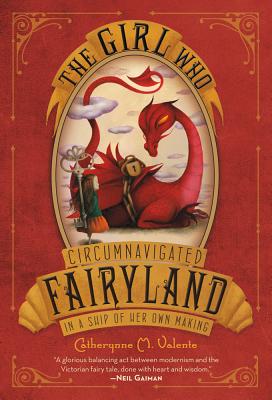
The Girl Who Circumnavigated Fairyland in a Ship of Her Own Making by Catherynne M. Valente


September is a very bored little girl.  Her father has shipped off to war and her mother is raising her alone.  Her mother works all day repairing engines in a factory.  They live in Nebraska, where there is nothing for a little girl like September to do.  She wishes endlessly to be taken off to Fairyland like so many bored children before her.  One day, while she is washing teacups, that wish comes true and September gets a visit from the Green Wind, riding on the Leopard of Little Breezes. They take her away to Fairyland, where she has the most amazing adventures.


The characters in this book are so unavoidably likable, despite their faults.  September is repeatedly called heartless, but we know she isn’t.  She is sometimes said to be selfish, but she is nowhere near it.  Even the villain is likable in her ability to be such a fantastic fairy tale villain.  Sure, she’s an evil ruler, but she’s just a kid.  An angry one at that. Of course the friends September makes along the way are the most wonderful friends anyone could ever hope to make. There's A-through-L, a Wyvern and Saturday, a marid, and of course Gleam, a kind-hearted paper lantern.


Valente is an exceptional writer.  She creates a Fairyland that is both familiar and fantastically strange.  Her imagination has run wild all over the pages of this book, and it’s a really, really mind-blowing imagination.  It’s not often that a writer can create a world so complete and easy to visualize.  Her descriptions are lush and vivid, even describing colors in more depth than I thought was possible.  It helps that she loves some of the same things that I do, like autumn and pumpkins and green smoking jackets, which she spends extra time applying her loving pen to.  Her vocabulary is luscious and so needed in books for young readers.


It’s impossible for me to write this review without pointing out the obvious fact that female characters like September are so needed in children’s literature.  September is an amazing little girl.  She makes friends easily and defends them without a thought.  She literally travels to the ends of the earth (without shoes, no less) to save them, and she does it alone.  She is willing to sacrifice everything for them. There’s no annoying underlying romance to it, as there is in other popular kids books.

It also helps that September is being raised by wrench-wielding, do-it-yourself mother, though we get only get small pieces of the woman she is. September
doesn’t get her strength from anyone but herself, which, like most of us, she has to learn along the way.

http://www.indiebound.org/book/9781250010193" target="_new">Buy it indie!

Monday, December 3, 2012

The Kobo eReader

Target Audience: eReader late-bloomers, those who are curious and nervous about technology, or your blind parent/grandparent, who wouldn't be caught dead with a large-print book.

Yep, you read that right, I'm blogging about an eReader. Due to popular demand and the emergence of a new brand, the bookstore I work in has finally started carrying the Kobo eReader. The booksellers are not thrilled about this, but at least this eReader comes to us as an indie-friendly version of Amazon's Kindle. It reads a lot like a Kindle, with eye-comforting ‘eInk’, which is very similar to reading on paper. This is not like reading on your computer or your iPad so it won't give you a headache. The indie-friendly part of it comes from the fact that when you purchase this from our store (or presumably any store) a percentage of your future purchases go to the store you bought it from. The Kobo was designed with independent stores in mind, so that our customers can buy eBooks with our independent store in mind as well.

I took the Koboglo home for a few evenings to test it out for myself. This eReader is black and white and features a frontlight that doesn't glare and makes reading in the dark a special treat. I’m still not a fan of eReaders as a whole, but I really liked this for reading in bed. I tend to read old paperbacks in bed and my reading light is heavy and sometimes flickers. I often give up on reading long before I am tired because the light is so annoying. I know, I know... I could get a different and better reading light, but I haven't, because I have to make stupid things difficult for some reason. The Koboglo is easy to see in the dark, but isn't so bright that it keeps my bedtime neighbor awake. There is no flickering, and once the book is loaded, it's responsive to page turns and bookmarking with no fuss. The light also means that I can get all the way under the covers in a Krysta-cocoon so my nose isn't cold on those chilly Vermont evenings. When I do that with my book light, it tends to fall off my book. Extra bonus: cats do not find eReaders as tasty as paper books.


As much as I enjoyed using the Koboglo at night, I must be an honest bookseller and point out that the Kobo is not the fastest eReader on the block. There were times when I tapped the cover of the book I wanted to read and then waited. And waited. And waited just a bit more. But, just when I thought the eReader had given up on life in general, it snapped out of it and loaded my book. However! Once the book was loaded, there was no waiting. In and out of standby mode took no time at all and when I wanted to pick up the book I got half way through the night before, it was there, waiting for me, with cookies.*


I wouldn't use it for my non-fic books because I do a lot of back and forth reading with those and sometimes underline bits I want to come back to later (or blog about).  I wouldn't recommend this (or any eReader) to people who like to take notes in their books.  While the option is there, it’s not as easy as just writing in a real book.  You can, however, dog-ear pages in the Kobo. (If you’re the kind of insane person who would do such a thing to a real book, then please yes do buy an eReader and stop mangling books. I bet you’re a spine breaker too, aren’t you?)  The final downside of this (or any) eReader, was given by my manager: When you have finished reading, you can not slam an eReader shut in that satisfying way only a book-lover can understand.

I'm now going to take a moment and explain why not all eReaders are created equal. While it's true you might be able to get an Amazon Kindle for maybe a bit cheaper and maybe it's a bit better than the Kobo, in terms of features and speed, there is a key difference that should matter to all readers, regardless of how they feel about buying from local and independent stores. When you pay for an eBook from Amazon, even though you are paying the same amount you would for just about any eReader, you do not own that book. Amazon can (and has) wiped Kindles owned by unsuspecting customers, with no notice or clear reason given. Because, even though the Supreme Court says corporations are people, those corporations are not legally bound to also have souls. Kobo doesn't do that. When you buy an ebook from Kobo, you own it. It's yours. End of story. Just like a real book. So if you're in the market for an eReader, a Kobo is a way to be tech savvy, stay indie, and own what you buy (which is what the cool kids are doing these days).

*Kobo does not provide cookies. As far as I know, no eReader does provide cookies. When they start providing cookies, I will be buying one. For now, I shall continue to beg everyone around me to provide cookies instead.
Monday, November 19, 2012

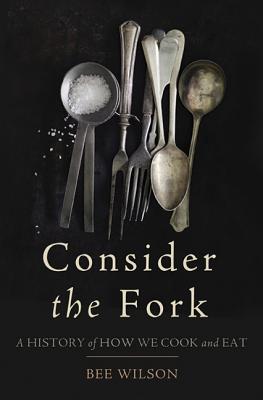
Consider the Fork by Bee Wilson

Target Audience: Food lovers and cooking enthusiasts. This would also work for someone who likes to read about cultural history and the history of everyday objects (see also: Brilliant by Jane Brox).

I love cookbooks, but I don't think about the ingredients as something that just magically appear in my kitchen.  I go to great lengths to know where my food comes from, who grew it, what went into producing it, and the kind of nourishment it provides. It's no secret that I love reading about food, but before reading Consider The Fork, I never really put much thought into my kitchen tools.  What of the vegetable peeler (which I don't own)? Or the wooden spoon (also don't own)? Or the ever-obvious knife (own many)? Wilson's detailed research changes the way we view all of those items we take for granted. After all, my great-great-great Italian grandmother didn't make her famous pesto in an electric food processor, but I'm not about to give mine up for the job.

Consider the Fork tells the deliciously fascinating history of cooking and culinary tools. From knives to coffee grinders to the kitchen fire itself, readers will relish every moment. Just how long did it take us to invent the vegetable peeler? How different are our whisks from the whisks of the Middle Ages? Consider the Fork takes the reader through the history of how we slice, cook, measure, grind, and mold our food.

The book starts out with the obvious beginning: pots and pans. Wilson explains that hundreds of years of cooking has yet to produce a material that will create a pan that will heat evenly, has non-stick qualities, is cost effective, won’t poison the eater, and is also durable. After years of trials and testing, an engineer named Chuck Lemme decided that cast iron rates highest among all available materials. Since I already have cast iron pans, this is the only chapter that doesn't make me immediately want to go out and buy things for my kitchen. Much.

Consider the Fork runs the risk of costing a small fortune for kitchen worshipers, such as myself. The chapter on knives had me all excited to buy a mezzaluna and a santoku, until I realized that the kitchen knife I use everyday is based on a santoku. The chapter on measuring has me convinced that I need to get digital kitchen scales and that it will solve all of my failures with baking.

The final chapter gives the history and origins of the modern kitchen. The kitchen as we know it did not exist until fairly recently. Before electricity, food was stored in cooler rooms away from the blazing heat of the cooking fire. Not until the fire was contained and the ice box was introduced, did food preparation and storage begin to take place in the same room as the cooking. It's odd to think that the room I consider to be the heart of my home would have been a strange sight just a century ago. Our modern obsession with the perfect kitchen is only possible because of the rich history of food preparation.

As a little bonus, each chapter is paired with an appliance that relates to it. These little sub-chapters are only about a page long and give an abbreviated history of a relevant kitchen tool. The pots and pans chapter ends with rice cookers and the measurement chapter ends with an egg timer. These little sections break up the book and give the reader a fun little history of some of our favorite kitchen objects.

Consider the Fork is also peppered with little illustrations of the tools that Bee refers to. I'm not always a fan of these kinds of pictures in books, because they can break up the text in weird ways and seem unnecessary. That being said, they are wonderful in this book. Annabel Lee depicts the implements Wilson refers to most often, which is necessary when trying to explain the subtle differences between certain kinds of knives and eggbeaters that the reader may have never heard of. Her pictures are simple and not at all distracting, all while capturing the personality of the book perfectly.

I will be bending over backwards to recommend this book to customers all holiday season. It is a must-have for any foodie or cooking enthusiast to savor. It's completely unique and it just came out, so you can be sure the recipient doesn't already own it, but will treasure it immediately as a delightful and juicy account of our kitchens.
Buy it indie!


Monday, November 12, 2012

One Hit Cookbook Wonders

Every now and again, while at work, I'll come across a customer sitting in the cookbook section copying down a recipe from one of our books. Some may take issue with that, but I've never really seen the harm in it. Who wants to buy a cookbook for just one recipe anyway? Oh wait, I would.

I've got tons of cookbooks and I'm constantly talking myself out of buying more. I don't even use cookbooks for 95% of my cooking, but I love the inspiration. I'd be lost without baking books, because although I can make a yummy dinner from a seemingly empty fridge, I can't bake to save my life. The thing about having the whole book, is that if you know one recipe is good, chances are, you'll like most of the others as well.

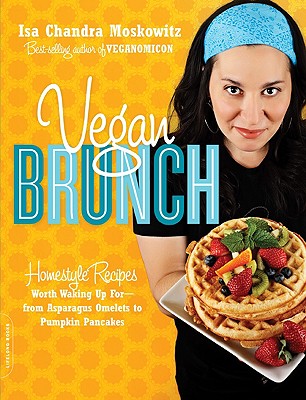
I've got several cookbooks that I bought, mostly because I love one specific recipe. Vegan Brunch is the biggest offender; I use the Perfect Pancake recipe every week for Pancake Saturdays, a weekly tradition in my home. After purchasing it, I discovered other fantastic recipes in there like English muffins, cocoa raspberry muffins, and Tofu Omelets (trust me) , but oh, man those pancakes turn out perfectly every time. You don't even need any fancy vegan things. I often substitute water for non-dairy milk and you'd never know the difference.

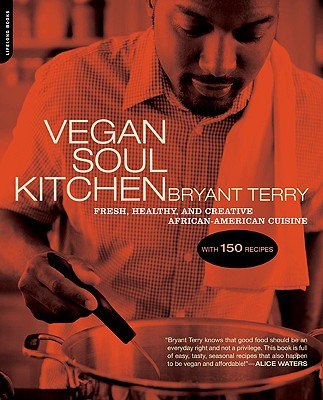
Vegan Soul Kitchen is another one. Well, actually, I use two recipes from that one with regularity. The coconut oil pie crust will come out perfectly no matter what and without tears. My co-workers don't believe me, but I copied down the recipe for some of them, so someday maybe they'll get over the fear of "strange vegan ingredients" and try it out. Truth be told, there are no "strange vegan ingredients" in anything I cook, but I guess even coconut oil is not a regular occurrence in non-vegan pantries. The other favorite from this book is the red rice. Bryant Terry does the most amazing and tasty things with rice, that I would never have thought of on my own. His book can be loved by vegans and non-vegans alike for his whole-food ingredients and his talent for re-thinking the mundane (like rice).

Jo Stepanik's The Uncheese Cookbook is a staple in my kitchen. I originally bought it years ago to help a non-vegan boyfriend come to terms with the loss of cheese whenever I cooked. I don't usually use vegan substitutes for animal products, because they're weird and icky. These are homemade sauces, dips, and blocks that are 100% all natural, because they are home made. You won't find any wacky, hard-to-pronounce ingredients in this book. Best of all, everything in the book can be ready to eat in a pinch. My favorite is the Gooey Grilled Cheese Sandwich or the Macaroni and Cheese Sauce. But the recipe I use most often is actually not a cheese alternative at all, since I still tend to make those only by request of dinner guests, but a pizza dough recipe. The book naturally falls open to that page when I pull it out monthly to make a yummy vegetable pizza.

I'm guilty of writing down recipes from a book I didn't think I'd want later, but my shelves then become cluttered with bits and scraps of paper, and I know I'll never find that awesome recipe for Mexican Chocolate Cupcakes again because I think my cat probably chewed it up while trying to get my attention. And if I can find the recipe again, I won't know what book it came from and which author to trust with my cupcake needs, because I wasn't smart enough to write that information down. I better stop now, because I've made myself hungry. So if you're in the market for a new cookbook, or a new recipe, you could get out a pen and paper in your local bookstore, but you might be missing out on so many other fantastic recipes that you might have found if you brought the book home.

Monday, November 5, 2012

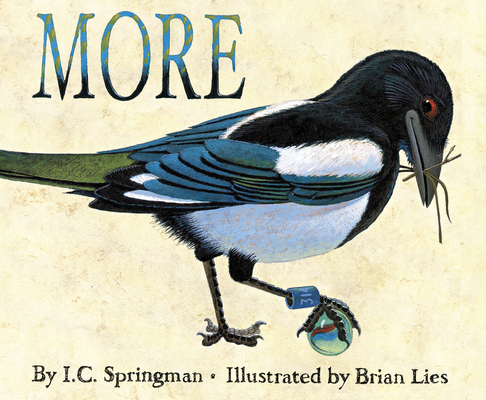
More By I. C. Springman, Illustrated by Brian Lies

Target Audience: The child of a book lover, especially, or any kid, age 1-7ish.

This is one of the best children's books to come out this year.  There are other great kid's books (which I'll try to get up before the holidays), but none that I love so much as this one.

The story is about a magpie that, in the beginning, has nothing.  Its mouse friend gives it a marble and it understands what it means to have something.  Suddenly the magpie wants more.  Just a little more.  Then a lot more.  And then way, way too much.  Luckily the mouse is still there to help.  It's a valuable lesson in a culture where your life's value can seemingly be measured by how much you own, rather than how much you really need.

One of the things I love about this book, is how few words it has.  Most of the story telling is inferred with pictures and left to the imagination.  That paragraph above has more words than the whole book, so it's great for the very little ones, and those just learning to read.  These factors will allow the book to grow with the child.  Kids at different points in their life will get different things from the book, so it's not like a board book that you read to a toddler a few times and then may end up throwing away when the child outgrows it.

The pages are full of all of the things the magpie has collected, like marbles, string, coins, stamps, toys, everything.  There's even a Pink Floyd cassette tape, which is obviously there for the adult reading the book, because the current generation has never seen or heard of a cassette tape (I know this because when I told a girl the only audio book available for the book she wanted as on cassette tape, she had no idea what I was talking about, which lead her mother and I to exchange a "kids these days" look).  Having all of these items adds another layer to the interactivity of reading to a child.  Even if the child can't read, perhaps she can count the marbles?  Maybe he can find all of the purple things?  What kind of coin is that? Where do you think that Lego brick came from?  Someone I sold it to planned to use it with kids with learning disabilities, which again, illustrates its versatility.

You can't talk about a kid's book without also talking about the art.  It is fantastic.  To me, a children's book is just as much art, as it is story, so even if the story is great, the art has got to support it.  Because the art does most of the story-telling in this book, there's even more pressure for it to be great, and illustrator Brian Lies lives up to my completely objective and outrageously-high standards.

I could never recommend a children's book if I didn't think it would be cherished forever, and perhaps saved for future children.  After all, I still own my favorite childhood books.


Buy it indie!

Saturday, October 13, 2012

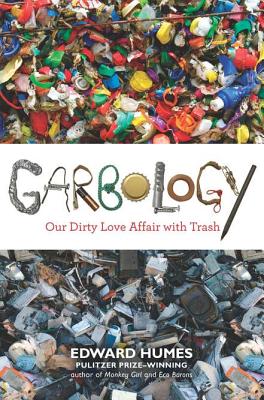
Garbology by Edward Humes

Garbology is one of the best environmental books I've ever read, and coming from me that's saying quite a lot.  Not only is the book accessible to anyone, it's also insanely interesting to anyone.  Humes is an excellent writer and journalist.  His statistics and sources are well cited and researched, and always relevant.

The subject of trash is an interesting one and something I've spent a lot of time thinking about.  We all create trash and by putting it in the trash can and setting the trash can on the curb, we believe we are doing our part in protecting the environment by not littering.  But where does it all go?  By sending it away to a dump are we really avoiding litter?  What really constitutes as litter anyway?  More importantly, why do we create so much trash to begin with?

Humes starts the book in the most logical places one can start a book about trash: the dump.  He begins the book by presenting the problem of garbage and the ever-looming question of what to do with it all.  He then gives a detailed and fascinating history of how trash was dealt with before the modern dumps, before we needed empty canyons to fill, because we wasted less, though Humes points out that trash was no less of an issue then as it is now.  He moves on to rogue trash, which doesn't make it to the landfill, and often ends up in the ocean, which has turned into a kind of plastic soup.

The second part of the book is dedicated to the study of trash, garbology.  Humes proposes that knowing we have a problem is not enough, we must get to the cause and the cultural habits behind the problem.  Here he turns to the worlds first garbologist.  Bill Rathje can probably go through your trash and know your household size, age range, income, and personal habits, without ever meeting you.  There's a lot of information out there abut trash, and he is the original trash fact-checker.

A team of people set up a trash tracking system to study where garbage goes after it is discarded and how long it takes to get there.  The results were scary.  Some bits of trash, especially recycled electronics (printer ink cartridges were the worst offenders) were shipped thousands of miles, back and forth across the country for days. Even though these things are being recycled (we hope), the system itself is so wasteful it's better to stick with reducing waste, rather than thinking we're off the hook by recycling.

The final part of the book is dedicated to solutions, from high-tech, large scale solutions, to simple at home solutions.  He gives us the story of Bea Johnson, whose family throw away virtually nothing.  Their households yearly waste can fit into a mason jar.  I thought I was doing well with only a five gallon bucket every  three months, but suddenly I found myself a little jealous.  I tend to agree with the low-tech solutions, mostly because the problem started with an abundance of technology and consumerism.  Personally, I think the best way to solve the problem of over-consumption is to stop consuming, though the thought of a garbage death ray is pretty rad, I must admit.

I've persevered through enough non-fiction to know that it can get rather dry and dull.  I've enjoyed books that I could never call page-turners, however, this book is absolutely a page-turner.  It has a very clear beginning, middle, and end.  In fact, as soon as I finished it, I couldn't wait to share the book with several other people.  I even went as far as calling a bookstore in Sante Fe, to purchase a copy for a friend who lives there.  I'll often mail a book to someone who I know would enjoy it, but I'm not really willing to part with this one permanently.

Buy it indie!

Tuesday, April 5, 2011

No Impact Man by Colin Beaven

I knew the moment I saw this book that I would love it.  And I do.  Beavan spends a lot of energy judging people and governments for the state of the environment, but does little to examine his own life, or even make the simplest changes.  After watching Anne Leonard's video, The Story of Stuff, he realizes it's time to make a change.  He devises a one year project called No Impact Man that will rid himself and his family of all possible environmental impact.

I'm a strong believer in doing all of it, or none of it, which made me really appreciate Beavan's amazing commitment.  I found a lot to be inspire by in this book, even though I consider my own footprint to be fairly light.  His complete refusal to create any waste really made me think about how much I waste, that I really don't need to.

The best thing about this book was that Beavan creates a more fulfilling life for himself and his family by simplifying.  Instead of rushing around, they make more time for each other.  Instead of take-out, they cook their own food and sit down with each other.  Instead of taking a cab, they enjoy the city by waling or biking.  Instead of watching TV, they play games.  On top of the improvement in their health and quality of life, they saved a ton of money by not shopping, using no electricity, cutting out disposable products, making their own cleaners, and not paying train and cab fairs. Not to mention what they will probably save long-term for medical bills by taking better care of themselves.

Beavan doesn't just write about what he did, he writes about why he did it.  He writes about what he got out of it.  His reflections about our way of life are so simple and logical, yet we hardly ever stop and really think about the fact that we can change if we want to.  He discovers that there is no reason for him to rush around when all he really wants to do is spend time with his family.  There is no reason to order take out when he can make the time to cook.  There is no reason to wrap his baby girl in toxic plastic diapers if they can take a few extra minutes to wash some fabric ones, which she prefers by the way.

The motivation behind every choice he makes is backed by statistics and very clear research.  The facts he uses throughout the book really drive his point home.  The need to get involved becomes emotional.  It's not some far-off problem we'll deal with when it happens, it's something we have to address now.  The fact that stuck with me most, which I have pondered every day since reading it, is this: 80% of everything manufactured on this planet today is created to be used only once.  We live on a planet of finite resources.  People all over the world die for oil, entire ecosystems are ruined for it, and we are throwing away 80% of everything we make with it after the first use?  Why?!?!

It's no wonder his book inspired me to change my own habits.  I'm not sure how anyone could read it and not be driven to change, even just a little.

Tuesday, April 6, 2010

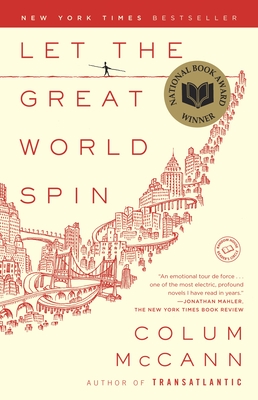
Let the Great World Spin by Colum McCann

I've always been captivated by stories of New York in the 70's and 80's, back when it was still a dangerous and trashy city, when Times Square was all smut and crime, without the Disney musicals.  Let the Great World Spin takes place in that era.  It has all the dirt and grime, but it is a story about people, so it also has their hope.  The stories move between the South Bronx, the Upper East Side and the Financial District (the southern tip of Manhattan).

The book takes the stories of many different people, from all parts of life, and weaves them together slowly and delicately.  Most of them do not even know they are connected; they may sense it, but they will never fully understand it.  An Irish priest and his brother, living in the South Bronx, one to find the underworld, the other trying to get out of it, become entangled in the lives of a group of prostitutes.  A rich mother loses her only son in Vietnam and tries to find other mothers to connect with.  A lost artist gets into a car accident that will change the course of all of their lives and set the story fully in motion.

The stories are all fictional, but they have something very important, and completely true, in common.  In 1974 Phillipe Petit strung a wire between the Twin Towers and by walking across it he created an instant network of people, all connected by the same miraculous moment.  Petit created one more piece of web to connect all of these stories.  At the very height of their stories, the climactic turning point, they all experience the man dancing on the wire between the Twin Towers.  His 140 foot length of cable, somehow crossed over the entire city at once, From the South Bronx, to the Upper East Side and back to the Financial District.

I loved this book.  It's definitely a must-read for any fiction lovers.

Friday, February 19, 2010

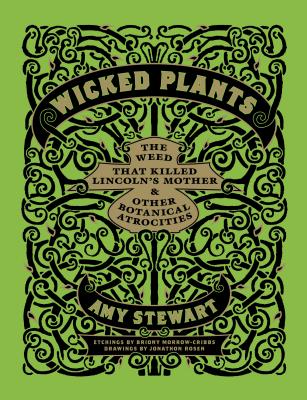
Wicked Plants - Amy Stewart

What a charming and interesting book.  I had no idea that so many common plants were so freaking bad for me and might possibly be able to kill me or my cat (this is imagining that I have a cat of course).  For instance, did you know that tulip bulbs can cause blisters on the hands of people who package them because they are slightly poisonous?  I mean, I always knew that tulips could inspire murder and ruin economies, but blisters?  Now that's crazy!

The book isn't all poison though.  It also highlights plants that are destructive, and illegal, intoxicating, unpleasant, and dangerous.  Apparently Stewart's opinion is that tobacco is the most dangerous plant of all.  I'd have to say I agree with her on that one, though the Australian Stinging Tree sounds excruciating.

There were so many little tid bits about the plants I see every day or even keep in my house.  The book isn't set up in a way that is meant to be shocking or scary; it's interesting and fun.  The author includes fun little facts and stories about most of the plants, which makes it more fun to read.  It's also such a nice size and comes with a ribbons attached to use as a book mark.  Why don't all hardcover book come with ribbons damn it?

I had mixed feelings about the art in the book.  The etchings, done by Briony Morrow-Cribbs, were very well done and interesting.  They were beautiful and eerie at the same time, very much in the spirit of the book as a whole.  They also remind me of the art my friend Lisa does, which helps.  However, the little illustrations, done by Jonathon Rosen, were so poor that they actually annoyed me.  They look like hasty doodles.  I actually checked out his website because his bio in the book had some impressive commissions.  His work varies from the doodly things seen in this book, to some impressive illustrations for newspapers and magazines.  Go figure.

Basically, when I was done reading this book, I wished there was a poison garden somewhere around here to visit.  I have such a new appreciation for the scary power of the plant world.  I always knew dangerous plants existed, but I guess I didn't realize just how common they were, and just how dangerous they could be.

Wednesday, January 13, 2010

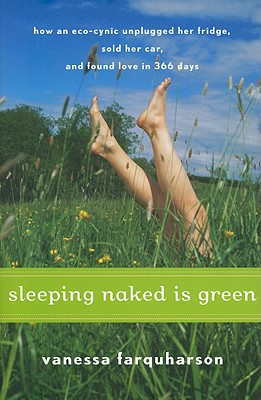
Sleeping Naked is Green by Vanessa Farquharson

Vanessa Farquharson is a movie critic for the Canadian newspaper National Post and doesn't care too much about the environment, until she sees "An Inconvenient Truth," and finally feels that she needs to do something. But what? She decides to take on a challenge of making one green change in her life every day for a year.

The book is divided into chapters by month and each month starts with a list of the changes she made each day. It starts out simply: Changing to recycled paper towels. But she soon starts to become desperate and shuts off her freezer, then her fridge. The order in which she makes her changes is... well, odd to say the least. For example, she turns off her fridge before putting a brick into her toilet tank. She gives up toilet paper before she gives up her vacuum. She also waits until day 198 to sign up for CSA.

She soon finds that being just a little green suddenly makes her want to be as green as possible. She wants to be the greenest in the green movement and often finds herself jealous and competitive of other environmentalists. At the same time she struggles with frustration over making certain changes and exhaustion from having to think new ones up. Some might be seen as a cop-out (writing only haiku poetry, signing up and then promptly taking down her profile on greensingles.com) but you have to give her credit and cut her some slack, she's making 366 (leap year) changes.


She whines endlessly about how hard it is to be an environmentalist, but when it comes time for her challenge to end, she keeps almost all of her green changes. This book is just further proof that anyone who is educated about the changes they can make and why they should make them (not to mention how easy it can often be), will make them. And they will start to care about it too. It's easy to claim ignorance about the environment and do nothing, but once you do know, it's harder to forget. She even manages to green her family a little, even though they were adamantly against environmentalism at the start.

This book is inspiring. And funny. And down to earth. Plus it's a great read. It's good information for environmentalists or just people curious at where to start. The green movement is often seen as either too extreme or just not enough, but Farquharson struggles to find a middle ground. Reading this book made it more apparent to me just how easy it could be to step up my own greening. It's nice to see all of her changes in a list in each chapter, because although she doesn't talk about each one, you still know what kinds of changes she is making.

Because Farquharson is a journalist, her writing is interesting and engaging. She talks about the changes and why she made them, but also what the result is on her life as a a whole. Not to mention she's hilarious. The book isn't just a list of changes that you can make, it's a story about making a difference. At the end Farquharson isn't a preachy environmentalist. She sticks with her own changes, because she sees no point in going back. But there's no denying that the story is an inspiration to those who read it. It's a story about how little changes can make a big difference, not just to the Earth, but to your entire life.