Mary Roach’s books have been on my to-read list for a long time. However, when your job depends on knowing what’s new and great, reading an author’s backlist can be difficult to find time for. Naturally, when Roach’s newest book came out, I jumped at the chance to finally make time for this intriguing writer. Right now I’m kicking myself for not having read her other titles sooner. Everything they say about Mary Roach is true. She’s exactly what a great science author should be: easy to understand, incredibly interesting, and outrageously hilarious. Outrageously.
In a way, I’m glad I waited. Gulp is the perfect follow-up to Salt, Sugar, Fat; It details some of the science that Moss hinted at. Gulp is a scientific exploration of digestion, from start (the nose) to finish, (the toilet). It may sound as though the book could be disgusting, but I assure you, it isn’t. Roach makes her intentions clear from the start: she wants to fascinate the reader, not cause disgust (much). In this, she achieves her goal. From the first chapter I was completely engrossed, but never grossed-out.
One of my favorite things about this book were the footnotes she sprinkled liberally throughout the book. They are like little asides to the reader; not quite pertinent to the main subject, but too interesting to be left out. It’s as though I’m sitting next to her in biology class and she is passing me silly notes about the subject until the bell rings. I found them distracting at first, but soon started looking forward to them, as a great tool for sharing extraneous information, without derailing the whole book. Her humor rivals that of David Sedaris and her best jokes are in these little notes. Thankfully, I am not in biology class, so I can giggle freely while reading, which I think Roach probably did as well while writing.*
I do most of my reading during my lunch break at work, which can make reading about digestion and bowel movements less than desirable. However, true to her oath in the introduction, this book isn’t gross, it’s interesting. There is so much I never knew about the digestive system, or more importantly, so much I didn’t realize I wanted to know about the digestive system. Roach interviews scientists and professionals involved in everything from saliva, to flatulence, to Elvis Presley's doctor. It would seem that Roach has no limits to journalistic inquiry, even emailing the United States Conference of Catholic Bishops for more information about the possible history of holy water enemas being used in exorcisms.
I would recommend reading this book next to an internet-ready device, because in some cases, Roach can only begin to scratch the surface of the story. I spent a considerable amount of time reading about Horace Fletcher; one chapter simply isn’t enough to cover someone like him. The book isn’t about Fletcher, Komodo dragons, competitive eating, or any number of equally interesting things Roach talks about; it’s about the science and stories that make up the alimentary canal, thus prompting me to look further into many of the subjects Roach brings up. For someone with an endless appetite for information (example: people who look up one thing on Wikipedia, only to get sucked in for two hours), Roach’s writing style can be dangerous and time consuming, but also heavenly.
Now that I’ve finished Gulp, I can’t wait to dig into that backlist. If Roach can make digestion, gassiness, and saliva this interesting, imagine what she can do with cadavers and superstition. Irresistible!
*Her fascination with names that correspond to professions reached its peak with Dr. Crapo who coined the term “Dung Lung.”
Buy it indie!
I
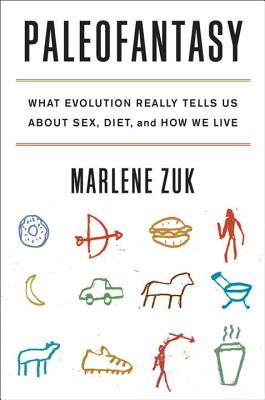
first heard of Paleofantasy when our rep from WW Norton, David
Goldberg, came in to the bookstore to talk about some upcoming releases.
Naturally I snatched up the book as though everyone in the room would
immediately lunge for it, but, as usual, my co-workers just stared at
me. It’s no secret that I love science, but this whole paleo-diet trend
that’s been making the rounds has made me even more passionate about my
desire to see science finally being taken into account before anyone
jumps on the paleo-bandwagon. Paleo-dieters
and lovers of the caveman lifestyle believe that homosapiens stopped
evolving some time around moving into caves and that modern man is not
fit for our current lifestyle. They blame all manner of diseases on the
idea that humans were not meant to live as we do now and that
agriculture is killing us. Marlene Zuk, a biologist and professor at
the University of Minnesota, argues that evolution doesn’t stop and to
argue that we were “meant” to do something is an argument that evolution
has some kind of end goal, which is a little ridiculous. Zuk combines
biology and anthropology to disprove many of the myths that
paleo-lifestyles are based on. Although we don't know exactly how early
man lived, Zuk dispels the most common ideas through meticulous
research and, best of all, science. This
book isn’t an attack on paleo-lovers, it’s a scientific answer to the
believe that we’d all be better off as hunter-gatherers. In many cases
the arguments made about caveman lifestyle are not true to begin with,
so there is no reason to believe that living that way now will be any
healthier. Zuk’s overall point was that there is no one way that
cave-dwellers lived. There were multiple societies, each with their own
way of living and eating. For example, Zuk explains how our ability to
digest dairy and grains has been a recent(relatively speaking) product
of evolution. However, there is evidence to suggest that some groups of
early-man did eat grains or dairy, while others didn’t.
Paleo-enthusiasts may be healthy because they make an effort to
exercise and not eat processed foods, but not because they don’t eat
grains or abstain from dairy. Zuk
isn’t on a mission to make paleo-people feel bad, or ruin their dreams
of caveman rockstardom; her only desire is to shed some light on the
science behind the the trends. In some cases, there is scientific
evidence to back up the healthfulness of paleo-lifestyles. For example,
barefoot runners run differently than those in sneakers and tend to
suffer fewer injuries. In terms of child-rearing, there seems to be a
case for raising children with alloparenting, letting a newborn set it’s
own eating and sleeping schedule, and keeping the child either in, or
near the parents’ bed. Paleofantasy
is a fascinating and accessible read that I had trouble putting down.
This book shows that while it’s no secret that many of our modern
problems are caused by poor lifestyle choices, that doesn’t mean we all
need to give up eyeglasses, stop eating quinoa, and give blood as often
as possible to try and imitate the life we think (without any real
scientific evidence) cavemen may have lived.
Buy it indie!
 Many people fantasize about a world long gone, where life was less complicated by modern day complexities and technology. Diamond has set out to clarify just what we gave up by moving out of hunter-gatherer bands and into high rises. His latest book compares traditional societies with modern lifestyles without glorifying or vilifying either.
Diamond explores just a few aspects of life, including conflict resolution, war, child rearing, the treatment of elderly, eating habits, and even how different people react (or don’t react) to coming in contact with a stranger. He argues that both modern cultures and traditional ones have some advantages and some weaknesses in all of these areas.
The fantasy of a less complicated life is just that, a fantasy. Traditional cultures may not have to worry about job security, but they do need to worry about famine and disease. Some may also need to worry about whether or not they will be seen as useful as they age, or if their family will kill them as they become more of a burden. Modern society also has the advantages of being able to live peacefully with people we don’t know, whereas Diamond explains that many traditional people might be inclined to kill a stranger on sight.
Just as there are advantages to modern society, there are areas where it falls behind the traditional ones. Looking specifically at American culture, most children speak and understand only one language, though recent studies have shown there are advantages to being multi-lingual, which most traditional societies are. Traditional societies also don’t suffer from the same western diseases that many Americans do, such as hypertension, type-2 diabetes, and heart disease. People in traditional societies tend to be fitter; their lower life expectancy is generally the result of less access to emergency medical care and the availability of food. According to Diamond, children in traditional societies also tend to focus on games that require cooperation and critical thinking, but almost never on competition.
Knowing nearly nothing about anthropology or traditional societies, I still found this book perfectly accessible and highly interesting. I found myself looking forward to each new chapter and the critiques and observations it would contain. As always, Diamond is a readable expert, making this book perfect for the casual reader or the scholar.
Buy it indie!