Saturday, October 13, 2012

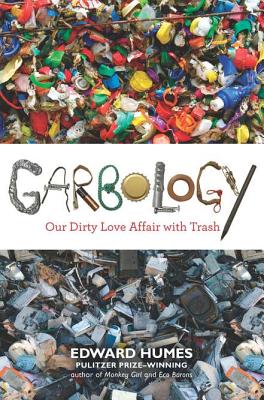
Garbology by Edward Humes

Garbology is one of the best environmental books I've ever read, and coming from me that's saying quite a lot.  Not only is the book accessible to anyone, it's also insanely interesting to anyone.  Humes is an excellent writer and journalist.  His statistics and sources are well cited and researched, and always relevant.

The subject of trash is an interesting one and something I've spent a lot of time thinking about.  We all create trash and by putting it in the trash can and setting the trash can on the curb, we believe we are doing our part in protecting the environment by not littering.  But where does it all go?  By sending it away to a dump are we really avoiding litter?  What really constitutes as litter anyway?  More importantly, why do we create so much trash to begin with?

Humes starts the book in the most logical places one can start a book about trash: the dump.  He begins the book by presenting the problem of garbage and the ever-looming question of what to do with it all.  He then gives a detailed and fascinating history of how trash was dealt with before the modern dumps, before we needed empty canyons to fill, because we wasted less, though Humes points out that trash was no less of an issue then as it is now.  He moves on to rogue trash, which doesn't make it to the landfill, and often ends up in the ocean, which has turned into a kind of plastic soup.

The second part of the book is dedicated to the study of trash, garbology.  Humes proposes that knowing we have a problem is not enough, we must get to the cause and the cultural habits behind the problem.  Here he turns to the worlds first garbologist.  Bill Rathje can probably go through your trash and know your household size, age range, income, and personal habits, without ever meeting you.  There's a lot of information out there abut trash, and he is the original trash fact-checker.

A team of people set up a trash tracking system to study where garbage goes after it is discarded and how long it takes to get there.  The results were scary.  Some bits of trash, especially recycled electronics (printer ink cartridges were the worst offenders) were shipped thousands of miles, back and forth across the country for days. Even though these things are being recycled (we hope), the system itself is so wasteful it's better to stick with reducing waste, rather than thinking we're off the hook by recycling.

The final part of the book is dedicated to solutions, from high-tech, large scale solutions, to simple at home solutions.  He gives us the story of Bea Johnson, whose family throw away virtually nothing.  Their households yearly waste can fit into a mason jar.  I thought I was doing well with only a five gallon bucket every  three months, but suddenly I found myself a little jealous.  I tend to agree with the low-tech solutions, mostly because the problem started with an abundance of technology and consumerism.  Personally, I think the best way to solve the problem of over-consumption is to stop consuming, though the thought of a garbage death ray is pretty rad, I must admit.

I've persevered through enough non-fiction to know that it can get rather dry and dull.  I've enjoyed books that I could never call page-turners, however, this book is absolutely a page-turner.  It has a very clear beginning, middle, and end.  In fact, as soon as I finished it, I couldn't wait to share the book with several other people.  I even went as far as calling a bookstore in Sante Fe, to purchase a copy for a friend who lives there.  I'll often mail a book to someone who I know would enjoy it, but I'm not really willing to part with this one permanently.

Buy it indie!

Monday, October 1, 2012

Growing up with banned books

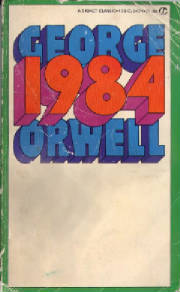
I was lucky enough to come from a family that didn't really believe in censorship, so my mother was always happy to read any books with me, or discuss them, if I showed an interest. She generally let me decide for myself what was too advanced, or too scary for me (I will also mention that watching The Shining all the way through is a right of passage in my family, where scaring the snot out of your kids is just part of raising them properly). When I was about 7 or 8, and just becoming interested in adult books, my mother read me1984, which has been banned repeatedly in schools, libraries, and sometimes entire countries.

What better book is there to teach us about the dangers of censorship and the tragedy of losing our autonomy? I still remember being drawn to the cover of her amazing edition from the 70's (I later lost that copy of the book when I accidentally dropped it in a dumpster years later, while taking out the trash. Apparently I couldn't put it down long enough to leave it in our apartment for even this short trip). Although I didn't understand all of it then, it did give me a healthy distrust of authority. My mother has always been proud of this trait in me, though my teachers, managers, and landlords less so. I'm not saying I would not have learned this trait without the book, but I am saying that had my mother tried to shelter or censor my life and my reading choices, I would not be the strong-willed, independent person I am today.

I'm not recommending that a parent read a 7-year-old anything by Orwell though, because that's completely insane. What I am saying is that it may seem like a small thing to ban someone from one little book, but one book eventually becomes many and then suddenly we've got a case of Fahrenheit 451 on our hands. The very notion of this infuriates me to no extent, because although I am often overcome with a desire to burn Snooki's book, as a book lover and free-spirit, I could never tell someone else what they have a right to read. Who knows, maybe someone could find it inspiring some day. That inspiration may or may not be to stay as far away from self-tanner as possible, but at least something can be gotten from it, right?

I remind myself of that every time I sell a copy of 50 Shades of Grey. Having not read it myself, I couldn't say for sure if it really is worthy of the loathing it gets from bibliophiles everywhere. That being said, I'm still not going to read it. But you can. Who knows, maybe it will inspire you to read something else next time. Actually, there's a lot of forbidden sex in 1984... maybe you'd like celebrate banned book week by picking up a copy of that as well?

Tuesday, June 21, 2011

Farewell My Subaru by Doug Fine


I stumbled upon this book in one of Brattleboro's FIVE bookstores.  It was on sale so I picked it up, thinking it looked like fun.  Turns out you can judge a book by its cover, because fun it is.  Doug Fine is a humorous writer and a great story teller.  At 200 pages it's a quick and enjoyable read but still full of insight.

Fine moves to the New Mexican desert with the goal of kicking his fossil fuel habit and getting off the grid.  He has no experience whatsoever with ranching, farming, or any of the things people need to be self-sufficient.  To top it off, he's a Wal-Mart addict.  But, he kicks his addiction early in the book and makes no secret of the fact that he asks for help whenever he can.  He also buys two goats to help him get his other habit off-grid: ice cream.

A few solar panels, and one veggie oil run monster truck later and Fine is well on his way to reaching his goals.  He plants a garden (several times, due to many crop-decimating hail storms), installs a solar hot water heater and gets himself some chickens.  He almost makes the task seem simple (given the right friends and enough money, of course).  He certainly makes it seem fun, especially with all of the humorous and well-placed recipes (rattlesnake stew when he discovers a rattlesnake near his home, although in this case the rattlesnake escapes unharmed).

The part that I found most interesting was his veggie oil car.  I had all but forgotten about these little miracles with my secret (ok, not so secret) obsession with buying an electric car and powering it with solar panels.  Of course a much cheaper option is to get an old diesel car and convert it to veggie oil.  It's a great deal all around because normally restaurants have to pay someone to pick up their used oil and normally drivers have to pay higher and higher prices for their gas.  The image of a massive fuel-guzzling truck roaring around town spurting out chinese food-scented emissions is almost too good to pas up!

My only criticism of this book is the lack of sources.  Throughout the story Fine drops a few facts and figures having to do with energy and resource consumption, typical statistics to find in a book on environmentalism, but he sites no sources.  Where did this information come from?  There is no bibliography, no where to go for further reading.  If he picked these facts up from the internet, what are the websites?  Who did the studies?  Who collected this data?  I've never come across a book with facts that lacked sources and I found the whole thing confusing.

All in all, it was a great book and although it's not in my section at the bookstore now, it will soon.

Buy it Indie!

Monday, April 25, 2011

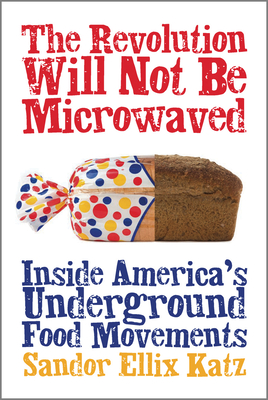
The Revolution Will Not Be Microwaved by Sandor Ellix Katz


I loved this book so much that the whole time I was reading it, I just wanted to find Mr. Katz and shake his hand.  And then invite him over for dinner.

The bookstore had this book sitting on the shelf for about a year and no one had purchased it.  Our book buyer wanted me to pull this lovely treasure from the shelf and return it to the publishers to make room for books that might sell better.  I couldn't do it.  Even though I had not yet read the book, I knew that with a title like this one, it had to be good.  So I promised to read the book, write a review and attempt to hand-sell the crap out of it.  And although my hand-selling skills are limited, I will certainly talk to anyone willing to listen about the reasons this book deserves a spot on the shelves.

This book mixes the some of the good bits of Pollan, Kingsolver, Bittman, even a bit of McKibben.  The point is, you can pick up this book anywhere along your journey to food knowledge and activism.  It can be a beginning, or it can be the next book in a long series of food system information.  Katz touches on environmentalism, heath, the overcomplicated food system, and even throws in some recipes.

What's even better is that Katz doesn't stop short after bringing up all of the problems, he gives examples of what others are doing to solve these problems.  He cites specific organizations and people who fight the system and how they are doing it.  Each chapter has several pages of resources for more information on the problems and solutions. The bibliography alone is enough reason to buy this book.  Getting through it will probably keep me occupied for years.

Buy it indie!

Tuesday, April 5, 2011

No Impact Man by Colin Beaven

I knew the moment I saw this book that I would love it.  And I do.  Beavan spends a lot of energy judging people and governments for the state of the environment, but does little to examine his own life, or even make the simplest changes.  After watching Anne Leonard's video, The Story of Stuff, he realizes it's time to make a change.  He devises a one year project called No Impact Man that will rid himself and his family of all possible environmental impact.

I'm a strong believer in doing all of it, or none of it, which made me really appreciate Beavan's amazing commitment.  I found a lot to be inspire by in this book, even though I consider my own footprint to be fairly light.  His complete refusal to create any waste really made me think about how much I waste, that I really don't need to.

The best thing about this book was that Beavan creates a more fulfilling life for himself and his family by simplifying.  Instead of rushing around, they make more time for each other.  Instead of take-out, they cook their own food and sit down with each other.  Instead of taking a cab, they enjoy the city by waling or biking.  Instead of watching TV, they play games.  On top of the improvement in their health and quality of life, they saved a ton of money by not shopping, using no electricity, cutting out disposable products, making their own cleaners, and not paying train and cab fairs. Not to mention what they will probably save long-term for medical bills by taking better care of themselves.

Beavan doesn't just write about what he did, he writes about why he did it.  He writes about what he got out of it.  His reflections about our way of life are so simple and logical, yet we hardly ever stop and really think about the fact that we can change if we want to.  He discovers that there is no reason for him to rush around when all he really wants to do is spend time with his family.  There is no reason to order take out when he can make the time to cook.  There is no reason to wrap his baby girl in toxic plastic diapers if they can take a few extra minutes to wash some fabric ones, which she prefers by the way.

The motivation behind every choice he makes is backed by statistics and very clear research.  The facts he uses throughout the book really drive his point home.  The need to get involved becomes emotional.  It's not some far-off problem we'll deal with when it happens, it's something we have to address now.  The fact that stuck with me most, which I have pondered every day since reading it, is this: 80% of everything manufactured on this planet today is created to be used only once.  We live on a planet of finite resources.  People all over the world die for oil, entire ecosystems are ruined for it, and we are throwing away 80% of everything we make with it after the first use?  Why?!?!

It's no wonder his book inspired me to change my own habits.  I'm not sure how anyone could read it and not be driven to change, even just a little.

Friday, April 16, 2010

That's Why We Don't Eat Animals by Ruby Roth

Kids ask so many freaking questions!  I have found myself in so many awkward situations because I wasn't exactly sure of the most appropriate way to explain certain things to a child.  My veganism is one of those tricky subjects.  I think kids should know where food comes from and that some of it may have come from an animal, but I don't think it's ok to scare kids into veganism, and it's inappropriate to step on another parent's toes.  However, kids ask questions because they need to understand their world and the different kinds of people that they share it with, vegans and meat-eaters alike.

This book is one great way to tackle that scary question, "What's a vegan?"  It's a wonderful book about vegetarianism for kids.  It's a very gentle and un-scary way to explain what veganism is and why some people don't eat animals.  The illustrations are very sweet, depicting happy animals in natural settings and sad animals in factory farms.  I also have to say that, as an adult, I still enjoyed this book for myself and managed to learn a few things from it.  Did you know that a heard of cows will all moo together until a missing member finds its way home? I didn't.

Now, don't even ask me where to begin when a kid wants to know where babies come from.  Go ask your mother.

Tuesday, April 6, 2010

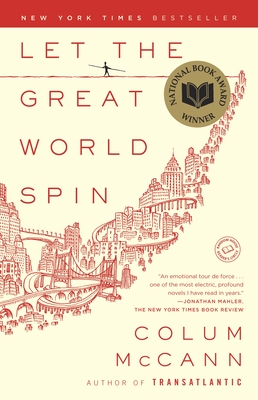
Let the Great World Spin by Colum McCann

I've always been captivated by stories of New York in the 70's and 80's, back when it was still a dangerous and trashy city, when Times Square was all smut and crime, without the Disney musicals.  Let the Great World Spin takes place in that era.  It has all the dirt and grime, but it is a story about people, so it also has their hope.  The stories move between the South Bronx, the Upper East Side and the Financial District (the southern tip of Manhattan).

The book takes the stories of many different people, from all parts of life, and weaves them together slowly and delicately.  Most of them do not even know they are connected; they may sense it, but they will never fully understand it.  An Irish priest and his brother, living in the South Bronx, one to find the underworld, the other trying to get out of it, become entangled in the lives of a group of prostitutes.  A rich mother loses her only son in Vietnam and tries to find other mothers to connect with.  A lost artist gets into a car accident that will change the course of all of their lives and set the story fully in motion.

The stories are all fictional, but they have something very important, and completely true, in common.  In 1974 Phillipe Petit strung a wire between the Twin Towers and by walking across it he created an instant network of people, all connected by the same miraculous moment.  Petit created one more piece of web to connect all of these stories.  At the very height of their stories, the climactic turning point, they all experience the man dancing on the wire between the Twin Towers.  His 140 foot length of cable, somehow crossed over the entire city at once, From the South Bronx, to the Upper East Side and back to the Financial District.

I loved this book.  It's definitely a must-read for any fiction lovers.

Sunday, March 14, 2010

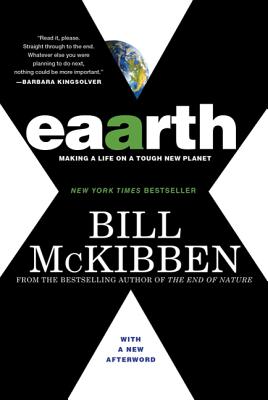
Eaarth by Bill McKibbon

If it were up to me I'd make this book required reading for everyone on the planet. It's one of the most important books ever written about climate change. In fact, the only reason it's not the most important book, is because books written in the 70's and 80's predicting climate change were far more important, though mostly ignored. If we had only listened then, we would need a book like Eaarth now.

The book starts strong. It caught my attention quickly, citing specific examples of climate change and it's results on both massive and small scales. I thought the reason the United States didn't take much interest in climate change was because those hardest hit by changes in the weather lived in other parts of the world, but the truth is, we've been hit too. The major difference is that American people, supported by the US government, have the money to import food, crank up the AC and even pack up and move if we want. However, at the rate we're going, we're going to reach a point where all the money in the world won't be able to buy you food that just won't grow, or remove the pollution from your water, or save your life when a hurricane crashes into your town.

But the book isn't all doom and gloom. McKibben simply wants to make sure you're listening. He wants you to know that you're not saving your children or your grandchildren anymore, you're saving yourself. He wants you to you fully understand that the planet has been fundamentally changed and it's not ever going to change back. The most we can do is stop things from getting worse. It's a really hard piece of information to swallow.

The second part of the book is more hopeful. McKibben doesn't have all of the answers to survival, but the ideas he has are really good ones. His points are valid. I really liked his idea of communities providing for themselves and looking out for each other. Why buy your electricity from a power plant when you can generate it yourself? There's real security in being able to take care of yourself. When oil starts to dwindle and the prices skyrocket why not power your electric car and your house at the same time with solar and wind power from your own yard? His point is that we can't wait for big government to save us and provide for us, we have to show them what we want. With the world in the state is in right now, bigger is not going to be better. We have to scale down, start taking back the power to care for ourselves.

McKibbon isn't attacking the government. He praises large scale projects like highways and general infrastructure. This country grew and grew and because of that, American people enjoy a fairly high standard of living. It's time to stop growing though. It's time to adapt to the world we created. No book I've yet read makes that more abundantly clear than Eaarth.

It ends on a good note. The kind of ending that makes it easier to recommend this book. He uses Vermont as a model for sustainability, but he talks about larger-scale projects as well; things that are working. He also points out the importance of the internet. The internet, this crazy tool that can connect anyone, anywhere. For example, I'm writing this review while sitting on a bus to NYC. The wireless internet connects me to millions of people, the biggest forum ever known. Any idea I'll ever have can instantly be shared with he world. There is no need for us all to be isolated, we can figure out solutions and move forward as a group. I can instantly find information about powering my own home, growing my own food, and converting my car to run on veggie oil by just getting online. The limitless connections of the internet are a gift when most of us don't even know our own neighbors. It's a hope, in a world where hope fades more and more the longer we live the way we do.

And, in the interest of saving paper, I will gladly loan you my copy.

Friday, February 19, 2010

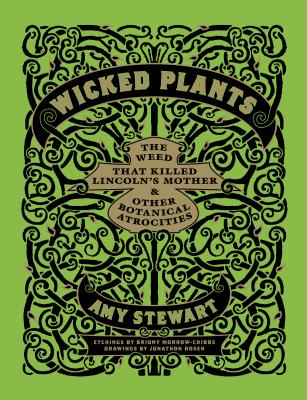
Wicked Plants - Amy Stewart

What a charming and interesting book.  I had no idea that so many common plants were so freaking bad for me and might possibly be able to kill me or my cat (this is imagining that I have a cat of course).  For instance, did you know that tulip bulbs can cause blisters on the hands of people who package them because they are slightly poisonous?  I mean, I always knew that tulips could inspire murder and ruin economies, but blisters?  Now that's crazy!

The book isn't all poison though.  It also highlights plants that are destructive, and illegal, intoxicating, unpleasant, and dangerous.  Apparently Stewart's opinion is that tobacco is the most dangerous plant of all.  I'd have to say I agree with her on that one, though the Australian Stinging Tree sounds excruciating.

There were so many little tid bits about the plants I see every day or even keep in my house.  The book isn't set up in a way that is meant to be shocking or scary; it's interesting and fun.  The author includes fun little facts and stories about most of the plants, which makes it more fun to read.  It's also such a nice size and comes with a ribbons attached to use as a book mark.  Why don't all hardcover book come with ribbons damn it?

I had mixed feelings about the art in the book.  The etchings, done by Briony Morrow-Cribbs, were very well done and interesting.  They were beautiful and eerie at the same time, very much in the spirit of the book as a whole.  They also remind me of the art my friend Lisa does, which helps.  However, the little illustrations, done by Jonathon Rosen, were so poor that they actually annoyed me.  They look like hasty doodles.  I actually checked out his website because his bio in the book had some impressive commissions.  His work varies from the doodly things seen in this book, to some impressive illustrations for newspapers and magazines.  Go figure.

Basically, when I was done reading this book, I wished there was a poison garden somewhere around here to visit.  I have such a new appreciation for the scary power of the plant world.  I always knew dangerous plants existed, but I guess I didn't realize just how common they were, and just how dangerous they could be.

Monday, February 1, 2010

Generation A by Douglas Coupland

Douglas Coupland's writing is a little Chuck Palahniuk, without trying as hard to be clever, and a little Kurt Vonnegut, though not so cynical. This book is not his first novel, but it almost reads like one. It doesn't make me interested to read his other books anytime soon, which is a bummer because I had high hopes for this book.

The story is about the foreseeable future when bees have gone extinct. No one has seen them for at least five years. Suddenly 5 different and seemingly unrelated people get stung. The book is told from their individual perspectives. Coupland does a good job of giving them all different personalities, though the writing style for each voice is basically identical. I found myself having trouble believing that the perceptive introvert was perceptive at all in certain chapters. At times he told his story like an ignorant fool.

I had bigger problem with the pacing. The story was all beginning and end, with no middle to speak of. We start out with the 5 people getting stung and they are whisked away to underground labs to be studied for a month, without explanation as to why. Then they go home, but before anything can happen there, they are whisked away yet again to a remote island where they find out why they were stung and what the results of being locked away underground were. Why even have them go home at all? Coupland seemed to be in a rush, but nothing gets me into a book like a writer who savors the story.

But I don't want to be misleading, it's a fun book and Coupland has a smart writing style. It was an easy read and an enjoyable one. It simply wasn't my favorite and I won't be rushing to re-read this book. I still stand by it being an interesting story idea, I just wish there could have been more to it. In a way that's a compliment. It's not like I didn't finish the book; I liked it enough to want more from it.